

If you want more people to find your website on Google, you need to learn how to do keyword research using AI tools. Keyword research helps you understand what people are searching for online. When you choose the right keywords, your blog posts have a better chance of ranking higher in search results and getting more visitors.
Today, AI keyword research is faster and easier than ever. Instead of spending hours searching for ideas, you can use AI keyword research tools like ChatGPT and other AI SEO tools to find useful keywords, understand search intent, and discover new content ideas. This saves time and helps you create content that matches what your audience is looking for.
In this beginner-friendly guide from UseAiLearn, you will learn how to do keyword research using AI tools step by step. You will also discover the best AI tools for keyword research, how to choose the right keywords, find long-tail keywords, understand search intent, and avoid common mistakes. By the end of this guide, you will have the confidence to do keyword research for SEO and create content that is more helpful for both readers and search engines.
Quick Answer
AI keyword research is the process of using AI tools like ChatGPT to find keyword ideas, understand search intent, and create better SEO content.
What Is Keyword Research?
Keyword research is the process of finding the words and phrases that people type into Google and other search engines. These words and phrases are called keywords. When you know what your audience is searching for, you can create content that answers their questions.
For example, imagine you have a blog about AI tools. Instead of writing a general article, you first check what people are searching for. You may find keywords like How to Create YouTube Scripts using AI Tools, the Benefits of Creating YouTube Scripts with AI, or the Best AI Tools for Writing YouTube Scripts. These keywords tell you what readers want to learn.
Here is another example. If someone wants to start a YouTube channel, they may search for how to start a YouTube channel, best video editing apps, or free AI video tools. If your article answers these questions, it has a better chance of appearing in Google search results.
Keyword research is important because it helps you:
- Understand what people are searching for.
- Choose topics that your audience cares about.
- Create helpful and useful content.
- Improve your chances of ranking higher on Google.
- Get more organic traffic without paying for ads.
Good keyword research is not just about finding popular keywords. You should also understand the search intent, which means the real reason why someone is searching for a keyword. When your content matches the user’s intent, readers are more likely to stay on your page and find the answer they need.
What Is AI Keyword Research?
AI keyword research is the process of using artificial intelligence (AI) tools to find the best keywords for your content. These tools help you discover what people are searching for, understand their search intent, and get ideas for new topics.
In the past, bloggers had to spend a lot of time looking for keywords manually. Today, AI keyword research tools can do many of these tasks much faster. They can suggest related keywords, long-tail keywords, common questions, and content ideas in just a few minutes.
For example, suppose you want to write an article about AI for students. You can ask an AI tool like ChatGPT:
“Find keyword ideas for AI tools for students.”
The AI may suggest keywords such as:
- AI tools for students
- best AI tools for studying
- free AI study tools
- AI apps for homework
- AI tools for college students
Now you have several keyword ideas that people may be searching for.
Here is another example. Imagine you want to write about blogging. Instead of thinking of keywords by yourself, you can use AI SEO tools to find keywords like:
- AI keyword research
- keyword research using AI
- best AI tools for keyword research
- keyword research for SEO
These suggestions help you choose a topic that matches what users are looking for.
However, AI is only a helper. It can give you many keyword ideas, but you should still check important details like search volume, keyword difficulty, and search intent before choosing your final keyword. This helps you create content that is useful for readers and has a better chance of ranking on Google.
Why Use AI Tools for Keyword Research?
Using AI tools for keyword research makes the process faster, easier, and smarter. Instead of spending hours searching for keyword ideas, AI can help you find useful keywords, understand what people are searching for, and plan better content in just a few minutes.
Whether you are a beginner or an experienced blogger, AI keyword research tools can save time and help you make better SEO decisions.
1. Save Time
Finding keywords manually can take a long time. AI tools can generate keyword ideas in seconds.
Example:
If you want to write about “AI for blogging,” you can ask ChatGPT to suggest related keywords. Within a few seconds, it may give you ideas like:
- AI for blogging
- AI blogging tools
- keyword research using AI
- AI content writing tools
This helps you start your research much faster.
2. Find More Keyword Ideas
AI can suggest related keywords, long-tail keywords, and common questions that you may not think of yourself.
Example:
If your main keyword is AI SEO tools, AI may also suggest:
- best AI SEO tools
- free AI SEO tools
- AI SEO tools for beginners
- AI tools for keyword research
These extra keywords can help you create more useful content.
3. Understand Search Intent
Good SEO is not only about finding keywords. You also need to know why people are searching for them.
AI can help you understand whether users want to:
- Learn something
- Buy a product
- Compare different tools
- Visit a specific website
When your content matches the user’s search intent, it has a better chance of ranking higher on Google.
4. Get New Content Ideas
Sometimes it is difficult to decide what to write next. AI can suggest new blog topics based on your main keyword.
Example:
If your topic is Future of AI in Blogging, AI may suggest articles like:
- How will AI Help Bloggers in the Future?
- Popular AI Tools for Blogging in the Future
- Benefits of AI in the Future of Blogging
- Will AI Replace Human Bloggers in the Future?
These ideas can help you build a complete content strategy.
5. Improve Your SEO Strategy
AI helps you organize keywords into related topics. This makes it easier to create multiple articles around one subject and build topical authority.
For example, instead of writing only one article about keyword research, you can also write about search intent, long-tail keywords, and AI SEO tools.
6. Learn Faster as a Beginner
If you are new to SEO, AI can explain difficult topics in simple language. It can also answer your questions and guide you through each step of keyword research.
This makes learning easier and helps you avoid common beginner mistakes.
Traditional Keyword Research vs AI Keyword Research
| Feature | Traditional Research | AI Keyword Research |
|---|---|---|
| Time Required | Takes more time | Much faster |
| Keyword Ideas | Limited ideas | Many keyword suggestions |
| Search Intent | Manual analysis | Quick guidance |
| Content Ideas | Need more research | AI suggests many ideas |
| Beginner Friendly | Can be difficult | Easy to learn |
| Speed | Slow | Fast |
Should You Rely Only on AI?
No. AI is a great assistant, but it should not be your only tool. Always check important details like search volume, keyword difficulty, and search results using trusted SEO tools. The best results come when you combine AI with your own research and judgment.
Note: All the examples I have used in this article—or will use later—are taken from articles on this website.
Best AI Tools for Keyword Research
There are many AI keyword research tools available today. Some tools are free, while others have paid plans with more advanced features. The best tool for you depends on your budget, experience, and SEO goals.
Let’s look at some of the best AI tools for keyword research.
1. ChatGPT
ChatGPT is one of the easiest AI tools for beginners. It can help you generate keyword ideas, create content outlines, understand search intent, and find long-tail keywords.
Best for:
- Brainstorming keyword ideas
- Finding long-tail keywords
- Understanding search intent
- Creating blog outlines
Example:
You can ask:
“I am writing a beginner-friendly SEO article about “How to Do Keyword Research Using AI Tools.”
Suggest:
1. One primary keyword
2. 10 secondary keywords
3. 10 long-tail keywords
4. Search intent
5. Related questions people ask
6. Semantic keywordsPresent the results in a clean table format. Do not explain each keyword. Only provide the lists in an organized way.“
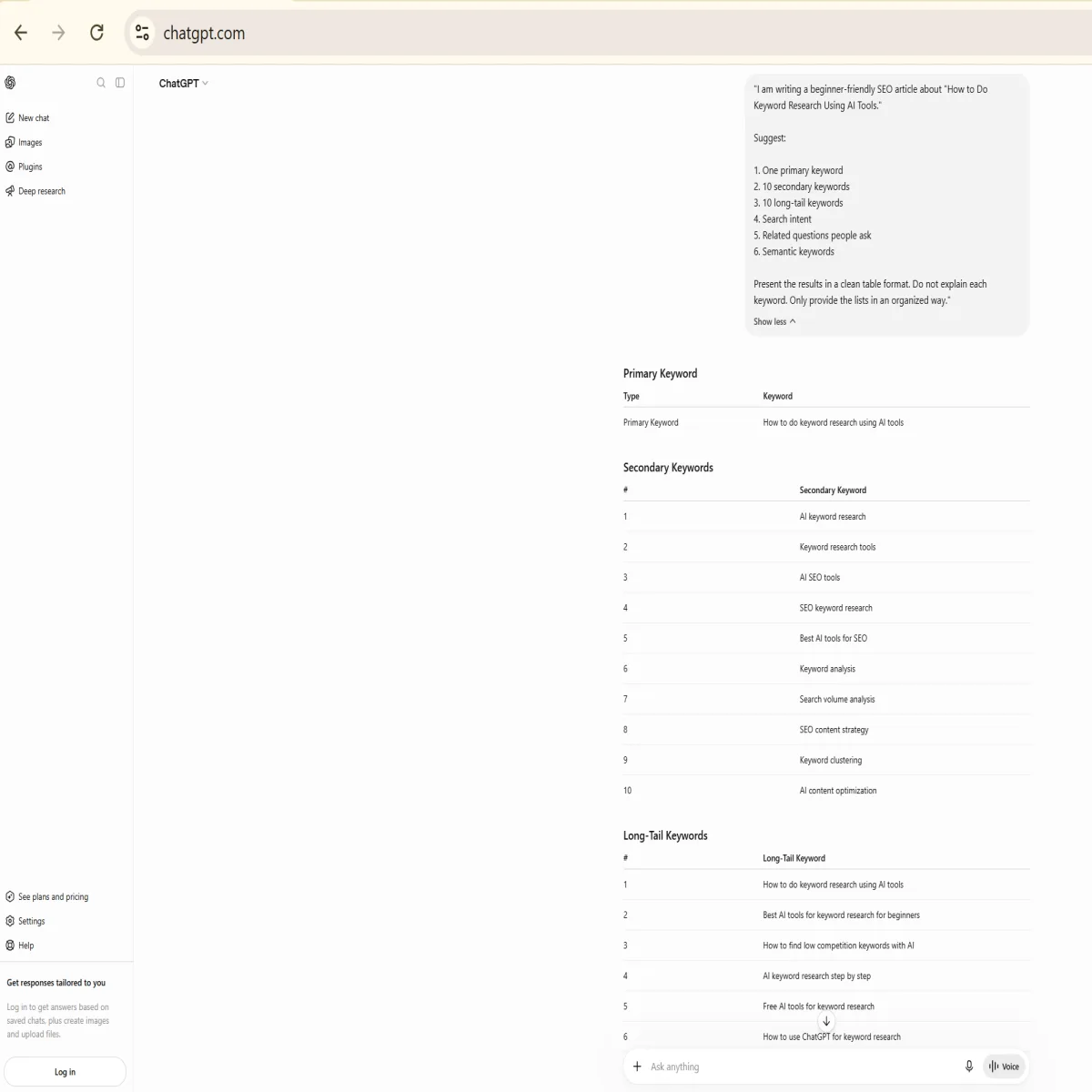
ChatGPT can quickly suggest many useful keyword ideas. However, it does not show real search volume or keyword difficulty. You should check those using an SEO tool.
Tips: ChatGPT may also suggest keywords that have little or no search demand. Always verify keywords before using them.
Pros
- Easy to use
- Great for beginners
- Fast keyword ideas
- Helps create content plans
Cons
- Does not provide live SEO data
- Keyword suggestions should be verified
2. Google Keyword Planner
Google Keyword Planner is a free tool from Google. It helps you find keyword ideas and shows estimated search volume.
Best for:
- Finding keyword ideas
- Checking search volume
- Planning Google Ads campaigns
Example:
Search for AI SEO tools, and Google Keyword Planner may suggest related keywords with monthly search estimates.
Note: Google Keyword Planner is mainly designed for advertisers, so some SEO keywords may appear as broad ranges instead of exact values.
Pros
- Free to use
- Data comes from Google
- Good for beginners
Cons
- Designed mainly for advertisers
- SEO data is less detailed than premium tools
3. Ahrefs
Ahrefs is one of the most popular SEO tools. It helps you discover keywords, analyze competitors, and find ranking opportunities.
Ahrefs is one of the largest SEO databases, making it useful for finding competitor keywords and content opportunities.
Best for:
- Professional SEO
- Competitor keyword research
- Keyword difficulty analysis
Example:
You can enter a keyword like Sell AI Generated Images and see related keywords, keyword difficulty, and top-ranking pages.
Pros
- Very detailed SEO data
- Strong competitor analysis
- Excellent keyword database
Cons
- Paid tool
- May be expensive for beginners
4. Semrush
Semrush is another powerful SEO platform. It helps with keyword research, competitor analysis, content planning, and website SEO.
Best for:
- SEO professionals
- Content marketers
- Complete SEO strategy
Example:
Search for Sell AI Generated Images, and Semrush can show related keywords, keyword difficulty, search volume, and similar questions.
Pros
- Many SEO features in one place
- Helpful keyword reports
- Great for content planning
Cons
- Paid subscription
- Can feel overwhelming for new users
Tips: It can also help you find keyword gaps between your website and your competitors.
5. Ubersuggest
Ubersuggest is a beginner-friendly SEO tool. It provides keyword ideas, search volume, SEO difficulty, and content suggestions.
Best for:
- Beginners
- Small websites
- Basic SEO research
Example:
Enter How to Sell AI Generated Images, and Ubersuggest will suggest related keywords and SEO metrics.
Pros
- Easy interface
- Affordable paid plans
- Good for beginners
Cons
- Smaller keyword database than some premium tools
Tips: It is a good choice for bloggers who have a limited budget.
6. KeywordTool.io
KeywordTool.io helps you discover long-tail keywords from Google and other platforms like YouTube, Bing, and Amazon.
It uses Google Autocomplete and other search suggestions to generate keyword ideas.
Best for:
- Long-tail keyword research
- YouTube SEO
- E-commerce keyword ideas
Example:
Search Create AI Images, and the tool will generate many keyword variations based on real search suggestions.
Pros
- Finds many long-tail keywords
- Supports multiple platforms
- Easy to use
Cons
- Many advanced features require a paid plan
Comparison Table
| Tool | Free Version | Paid Version | Best For |
|---|---|---|
| ChatGPT | Yes | Yes | Brainstorming, outlines, search intent |
| Google Keyword Planner | Yes | No | Search volume and keyword ideas |
| Ahrefs | Limited | Yes | Professional SEO and competitor research |
| Semrush | Limited | Yes | Complete SEO strategy |
| Ubersuggest | Yes | Yes | Beginners and small websites |
| KeywordTool.io | Yes | Yes | Long-tail keyword research |
Which Tool Should You Choose?
If you are just starting, ChatGPT and Google Keyword Planner are great choices because they are easy to use and cost little or nothing.
If you want more detailed SEO data, competitor analysis, and advanced keyword research, tools like Ahrefs and Semrush are better options.
A smart strategy is to use both AI and SEO tools together. For example, you can use ChatGPT to generate keyword ideas and blog outlines, then use Google Keyword Planner, Ahrefs, or Semrush to check search volume, keyword difficulty, and competition before writing your article.
My Experience
At UseAiLearn, I usually use ChatGPT to brainstorm keyword ideas. After that, I verify every keyword using Google Keyword Planner before writing an article. This simple workflow saves time and helps me choose better keywords.
Step-by-Step Guide to Keyword Research Using AI Tools
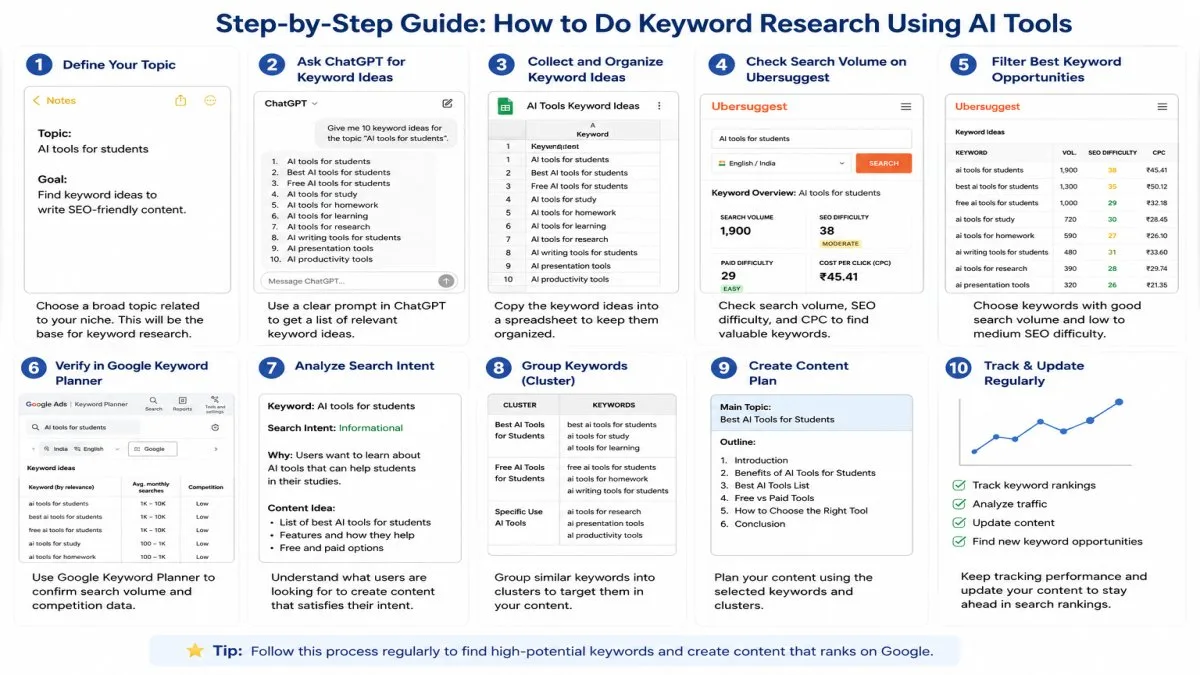
Now that you know what AI keyword research is and which tools you can use, let’s learn how to do keyword research using AI tools step by step.
Step 1: Choose Your Topic
Start by deciding what you want to write about. Your topic should match your website and help your audience solve a problem.
Example:
If your website is about AI, your topic could be:
- AI tools for students
- AI image generators
- AI for blogging
- AI SEO tools
A clear topic makes keyword research much easier.
Step 2: Find a Seed Keyword
A seed keyword is the main idea of your topic. It is usually one or two words and helps AI tools find more keyword ideas.
Example:
Topic: AI for Blogging
Seed Keyword:
AI blogging
You can also use:
- AI writing
- AI SEO
- AI tools
Step 3: Ask AI for Keyword Ideas
Now open an AI tool like ChatGPT and ask it to generate keywords.
Example Prompt:
“Suggest one primary keyword,
10 secondary keywords,
10 long-tail keywords,
search intent,
and related questions
for the topic AI blogging.”
AI may suggest keywords like:
- AI blogging tools
- AI blogging for beginners
- AI content writing
- best AI tools for blogging
- free AI blogging tools
Write down the keywords that match your topic.
Step 4: Understand Search Intent
Before choosing a keyword, ask yourself:
Why is someone searching for this keyword?
There are four common types of search intent:
| Search Intent | Example |
|---|---|
| Informational | How to use AI for blogging |
| Commercial | Best AI writing tools |
| Transactional | Buy AI writing software |
| Navigational | ChatGPT login |
Choose keywords that match the goal of your article.
Step 5: Find Long-Tail Keywords
Long-tail keywords are longer and more specific. They usually have less competition and attract the right audience.
Example:
Instead of:
AI tools
Use:
- best AI tools for bloggers
- free AI tools for SEO
- AI keyword research for beginners
These keywords are easier to rank for and answer more specific questions.
Step 6: Check Search Volume and Keyword Difficulty
AI gives you keyword ideas, but you should also check:
- Monthly search volume
- Keyword difficulty
- Competition
You can use tools like Google Keyword Planner, Ahrefs, or Semrush for this step.
Choose keywords that have a good balance of search volume and competition.
Step 7: Analyze Your Competitors
Search your main keyword on Google and look at the top-ranking articles.
Check things like:
- What topics do they cover?
- How long is their article?
- Which questions do they answer?
- Can you explain the topic better?
Your goal is not to copy them. Your goal is to create more helpful content.
Step 8: Choose Your Primary and Secondary Keywords
After your research, select:
- One primary keyword
- A few secondary keywords
Example:
Primary Keyword
How to Do Keyword Research Using AI Tools
Secondary Keywords
- AI keyword research
- AI keyword research tools
- keyword research using AI
- AI SEO tools
- keyword research for SEO
Use these keywords naturally throughout your article.
Tips: Avoid choosing more than one primary keyword for a single article.
Step 9: Create Your Article Outline
Before you start writing, make a simple outline.
For example:
- Introduction
- What Is Keyword Research?
- What Is AI Keyword Research?
- Best AI Tools
- Step-by-Step Guide
- Common Mistakes
- Quick Summary
- FAQs
- Conclusion
An outline keeps your article organized and easier to read.
Step 10: Review Your Keywords Before Publishing
Before publishing your article, check that:
- Your primary keyword appears naturally in the title and introduction.
- Secondary keywords are used where they fit.
- You have answered the reader’s questions.
- Your content is easy to read.
- There is no keyword stuffing.
And also check:
- Title
- Meta Description
- Image Alt Text
- Internal Links
- External Links
- Schema
- URL
Remember, writing for people is more important than writing only for search engines.
Quick Example
Imagine you want to write about AI tools for students.
Your research could look like this:
| Step | Example |
| Topic | AI Tools for Students |
| Seed Keyword | AI tools |
| Primary Keyword | Best AI Tools for Students |
| Secondary Keywords | free AI study tools, AI homework apps, AI learning tools |
| Search Intent | Informational |
| Final Goal | Write a helpful guide for students |
By following these simple steps, you can find better keywords, understand your audience, and create content that has a better chance of ranking on Google.
Example of AI Keyword Research
Now let’s look at a real example of AI keyword research. This will help you understand how to do keyword research using AI tools from start to finish.
At UseAiLearn, this is the simple keyword research workflow I follow before writing every article. This will give you a practical example of how to actually use AI tools for keyword research when writing blog posts for your website.
Step 1: First of all, I choose a topic.
Why I selected this keyword
Topic:
AI Tools for Students
Reason
- Clear search intent
- Beginner friendly
- Matches article topic
Step 2: Find a Seed Keyword
My seed keyword is:
AI tools
This is the main keyword that AI will use to generate more ideas.
Step 3: I will Ask AI for Keyword Ideas.
I will use a prompt like this:
Suggest keyword ideas for a blog about AI tools for students.
AI may suggest keywords such as:
- best AI tools for students
- free AI tools for students
- AI study tools
- AI apps for homework
- AI learning tools
- AI tools for college students
- AI tools for online learning
Now I have several keyword ideas to choose from.
Note: Don’t blindly copy every keyword suggested by AI.
Step 4: Checking search intent
After that, I will understand why people are searching for these keywords.
For this topic, the search intent is mainly Informational because users want to learn about the best AI tools for studying.
Step 5: Checking SEO Data
After obtaining keyword ideas from AI, I will vet them using SEO tools like Google Keyword Planner, Ahrefs, or Semrush.
I’ll see:
- Search volume
- Keyword difficulty
- Competition
- Related keywords
This helps me choose a keyword that has a good chance of ranking.
Step 6: I will select the final keywords.
After checking the SEO data, I will choose:
Primary Keyword
Best AI Tools for Students
Secondary Keywords
- free AI tools for students
- AI study tools
- AI learning tools
- AI apps for homework
These keywords naturally support my main topic.
Step 7: Creating a Simple Outline
Now, I will use AI again to create the outline of the article.
For example:
- Introduction
- What Are AI Tools for Students?
- Benefits of AI Tools
- Best AI Tools for Students
- How to Choose the Right AI Tool
- FAQs
- Conclusion
This makes writing much easier and keeps my article well-organized.
Tips: I don’t publish an article until I check whether the keyword matches the reader’s search intent.
AI Keyword Research Workflow
| Step | Example |
|---|---|
| Topic | AI Tools for Students |
| Seed Keyword | AI tools |
| AI Keyword Suggestions | best AI tools for students, AI study tools, free AI tools |
| Search Intent | Informational |
| SEO Check | Search volume, keyword difficulty, competition |
| Primary Keyword | Best AI Tools for Students |
| Secondary Keywords | AI study tools, AI learning tools, AI apps for homework |
| Final Step | Create a helpful article outline |
What Can We Learn from This Example?
This example shows that AI makes keyword research faster, but you should not stop after getting keyword ideas. Always check search volume, keyword difficulty, and search intent before choosing your final keyword.
The best results come when you use AI for ideas and trusted SEO tools to verify the data. This combination helps you create useful content that is more likely to rank on Google.
Best Prompts for ChatGPT Keyword Research
ChatGPT can help you with AI keyword research, but the quality of the results depends on the prompt you use. A clear prompt gives better keyword ideas and saves time.
Here are some of the best prompts you can use for keyword research using AI.
1. Find Keyword Ideas
Use this prompt to get a list of keywords for your topic.
Prompt:
Give me 20 keyword ideas for the topic “AI tools for students.”
Example Result:
- best AI tools for students
- free AI tools for students
- AI study tools
- AI learning apps
- AI homework tools
2. Find Long-Tail Keywords
Long-tail keywords are more specific and often easier to rank for.
Prompt:
Give me 15 long-tail keywords for “AI keyword research.”
Example Result:
- AI keyword research for beginners
- how to do keyword research using AI tools
- best AI keyword research tools
- free AI keyword research tools
- AI keyword research guide
3. Find Related Keywords
Use this prompt to discover similar keywords that match your topic.
Prompt:
Suggest related keywords for “AI SEO tools.”
Example Result:
- AI SEO software
- AI tools for SEO
- AI content optimization
- AI search engine optimization
- SEO AI assistant
4. Understand Search Intent
This prompt helps you understand what users want when they search for a keyword.
Prompt:
Explain the search intent for the keyword “AI keyword research.”
Example Result:
The search intent is Informational because users want to learn how AI can help with keyword research.
5. Generate Blog Topic Ideas
If you are not sure what to write, ChatGPT can suggest blog topics.
Prompt:
Give me 10 blog topic ideas related to AI keyword research.
Example Result:
- How to Do Keyword Research Using AI Tools
- Best AI Tools for Keyword Research
- Common Keyword Research Mistakes
- How to Find Long-Tail Keywords
- AI SEO Tips for Beginners
6. Create a Content Outline
After choosing your keyword, ask ChatGPT to create an outline.
Prompt:
Create an SEO-friendly outline for the keyword “How to Do Keyword Research Using AI Tools.”
This saves time and helps you organize your article.
7. Find Frequently Asked Questions
People often search for questions before reading an article.
Prompt:
Give me the most common questions people ask about AI keyword research.
Example Result:
- What is AI keyword research?
- Can ChatGPT do keyword research?
- Which AI tool is best for keyword research?
- Are free AI keyword research tools good enough?
Adding these questions to your FAQ section can make your article more helpful.
8. Find Semantic Keywords
Semantic keywords are words and phrases related to your main keyword. They help search engines understand your content better.
Prompt:
Suggest semantic keywords for “keyword research using AI.”
Example Result:
- search intent
- keyword difficulty
- search volume
- long-tail keywords
- SEO strategy
- organic traffic
Use these naturally in your article instead of repeating the same keyword many times.
Tips for Writing Better Prompts
To get better results from ChatGPT:
- Be clear about your topic.
- Mention your target audience.
- Ask for beginner-friendly ideas if needed.
- Request long-tail keywords and related keywords.
- Ask ChatGPT to explain its suggestions.
- Always verify keyword data with an SEO tool before using it.
Example Prompt for Beginners
If you are new to SEO, you can use this simple prompt:
I am a beginner blogger. Help me find the best keywords for the topic “How to Do Keyword Research Using AI Tools.” Suggest one primary keyword, 10 secondary keywords, long-tail keywords, search intent, and a simple SEO-friendly article outline.
This single prompt gives you a strong starting point for writing an SEO-friendly article.
Common Keyword Research Mistakes
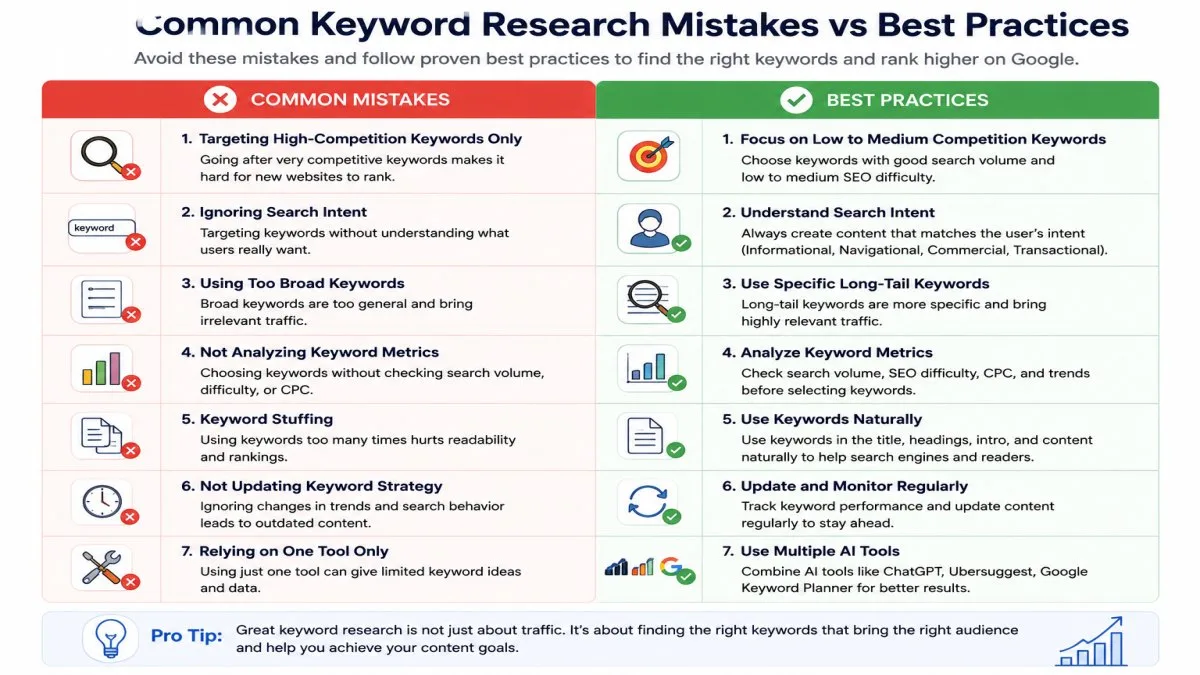
Keyword research is one of the most important parts of SEO. But many beginners make simple mistakes that can stop their content from ranking on Google. If you avoid these mistakes, you can create better content and improve your chances of getting more organic traffic.
Let’s look at the most common keyword research mistakes.
1. Choosing Only High Search Volume Keywords
Many beginners think that keywords with the highest search volume are always the best. This is not true. High-volume keywords usually have high competition, making them difficult for new websites to rank for.
Example:
Instead of choosing:
- AI tools
You can choose a more specific keyword like:
- best AI tools for students
- free AI tools for bloggers
These long-tail keywords are often easier to rank for.
2. Ignoring Search Intent
A keyword may look perfect, but if your content does not match what users want, it may not rank well.
Example:
Someone searches for:
best AI writing tools
They want to compare different tools, not read a long article about the history of AI.
Always create content that answers the user’s real question.
3. Using Too Many Keywords (Keyword Stuffing)
Some people repeat the same keyword again and again because they think it will improve SEO.
This is called keyword stuffing, and it can make your article difficult to read.
Bad Example:
AI keyword research is the best AI keyword research because AI keyword research helps with AI keyword research.
Good Example:
AI keyword research helps you find useful keywords faster and create better SEO content.
Use your primary and secondary keywords naturally.
4. Not Checking Keyword Difficulty
Some keywords are very difficult to rank for because many popular websites already target them.
Before choosing a keyword, check its keyword difficulty using an SEO tool.
This helps you choose keywords that are more realistic for your website.
5. Ignoring Long-Tail Keywords
Long-tail keywords are more specific and often have lower competition.
Example:
Instead of:
- AI tools
Use:
- best AI tools for content writers
- free AI tools for SEO beginners
These keywords usually attract people who know exactly what they need.
6. Trusting AI Without Verification
AI tools can give excellent keyword ideas, but they do not always provide real-time SEO data.
Always verify important details like:
- Search volume
- Keyword difficulty
- Competition
- Search intent
Use trusted SEO tools before making your final decision.
7. Copying Competitors
Looking at competitors is a good idea, but copying their content is not.
Instead, ask yourself:
- Can I explain this topic more clearly?
- Can I add better examples?
- Can I answer more user questions?
Your goal is to create more helpful content, not duplicate someone else’s work.
8. Forgetting to Update Keyword Research
Search trends change over time. A keyword that worked last year may not be the best choice today.
Review your keyword research regularly and update your content when needed.
This helps your articles stay useful and relevant.
Quick Summary
Avoid these common mistakes:
- Choosing only high-volume keywords
- Ignoring search intent
- Keyword stuffing
- Not checking keyword difficulty
- Ignoring long-tail keywords
- Trusting AI without verification
- Copying competitors
- Never updating your keyword research
By avoiding these mistakes, you can create content that is more useful for readers and has a better chance of ranking higher on Google.
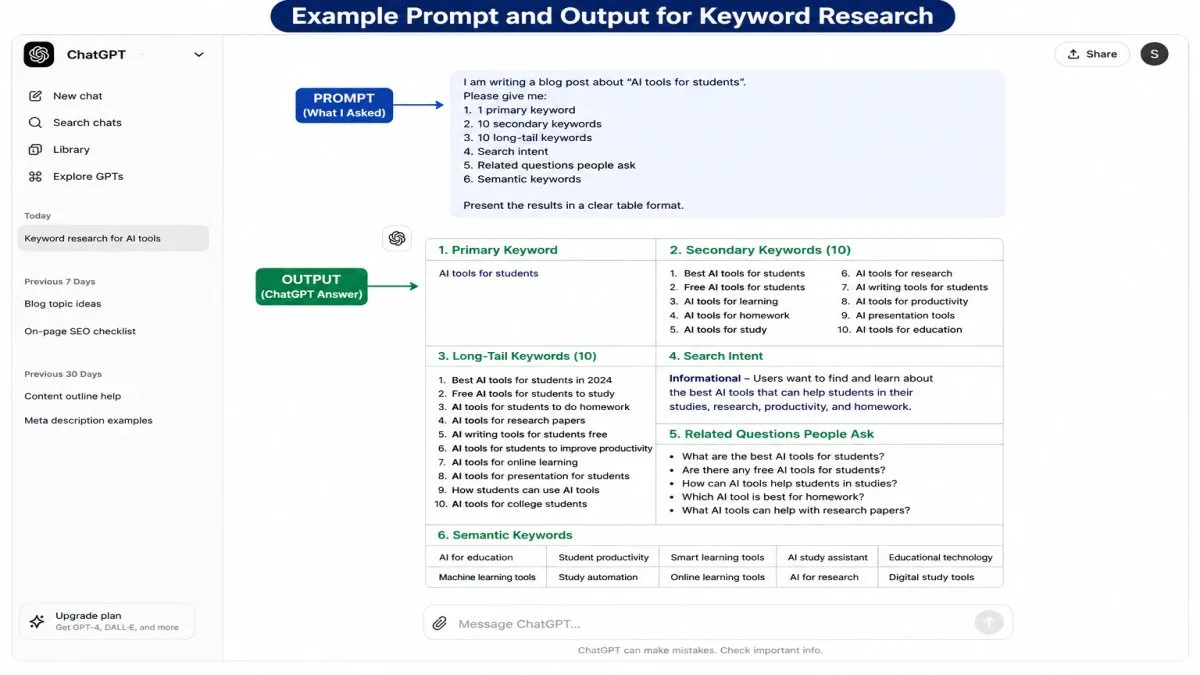
Best Practices for AI Keyword Research
Using AI tools for keyword research can save time and improve your SEO. However, following the right practices is important if you want better results. These simple tips will help you choose better keywords and create more useful content.
1. Start with One Clear Topic
Always begin with one topic instead of trying to cover many topics in one article.
Example:
Good topic:
- How to Do Keyword Research Using AI Tools
Not good:
- AI tools, blogging, SEO, YouTube, and social media in one article
A focused topic is easier for readers to understand and easier for Google to rank.
2. Use AI to Find Ideas, Not Final Answers
AI is great for generating keyword ideas, blog topics, and content outlines. But you should always review its suggestions before using them.
Example:
ChatGPT suggests a keyword.
Then you check its search volume and keyword difficulty using an SEO tool.
This helps you make better decisions.
3. Choose Keywords That Match Search Intent
Always ask yourself:
What is the user trying to find?
If someone searches for:
best AI keyword research tools
They expect a list of tools with features, pros, and cons—not a history of AI.
When your content matches search intent, readers stay longer on your page.
4. Use Long-Tail Keywords Naturally
Long-tail keywords help you reach the right audience. Add them naturally in your headings and paragraphs.
Example:
Instead of repeating:
AI keyword research
Use related phrases like:
- how to do keyword research using AI tools
- AI keyword research for beginners
- best AI tools for keyword research
This makes your writing sound natural.
5. Create Helpful Content First
Your first goal should be helping your readers, not just ranking on Google.
Ask yourself:
- Does this article answer the reader’s question?
- Is it easy to understand?
- Does it include useful examples?
Helpful content builds trust with your audience.
6. Check Your Competitors
Read the top-ranking articles for your keyword.
Look at:
- What topics they cover
- What examples they use
- Which questions they answer
Then create content that is clearer, more complete, and easier to understand.
Do not copy their content.
7. Keep Your Content Updated
SEO changes over time. Search trends and AI tools also change.
Review your articles every few months and update:
- New AI tools
- New examples
- Updated information
- Better keywords
Fresh content has a better chance of staying useful.
8. Write in Simple Language
Avoid difficult words and long sentences.
Imagine you are explaining the topic to a beginner.
Simple writing helps:
- Students
- New bloggers
- Small business owners
- Readers who are learning SEO
Easy-to-read articles also improve the user experience.
9. Use Keywords Naturally
Your primary keyword should appear naturally in important places like:
- Title
- Introduction
- Headings
- Conclusion
Use secondary keywords only where they fit naturally.
Never force keywords into every sentence.
10. Review Before Publishing
Before you publish your article, ask yourself:
- Is the information correct?
- Are the keywords used naturally?
- Did I answer the user’s questions?
- Is the article easy to read?
- Are there any grammar or spelling mistakes?
A final review can improve the quality of your article.
Quick Checklist
Before publishing, make sure you:
- ✔ Choose one clear topic
- ✔ Understand search intent
- ✔ Use AI for ideas
- ✔ Verify keywords with SEO tools
- ✔ Use long-tail keywords naturally
- ✔ Write helpful content
- ✔ Add real examples
- ✔ Review grammar and readability
- ✔ Update articles regularly
Following these best practices will help you create high-quality content that is useful for readers and has a better chance of ranking on Google.
Can AI Replace Traditional Keyword Research?
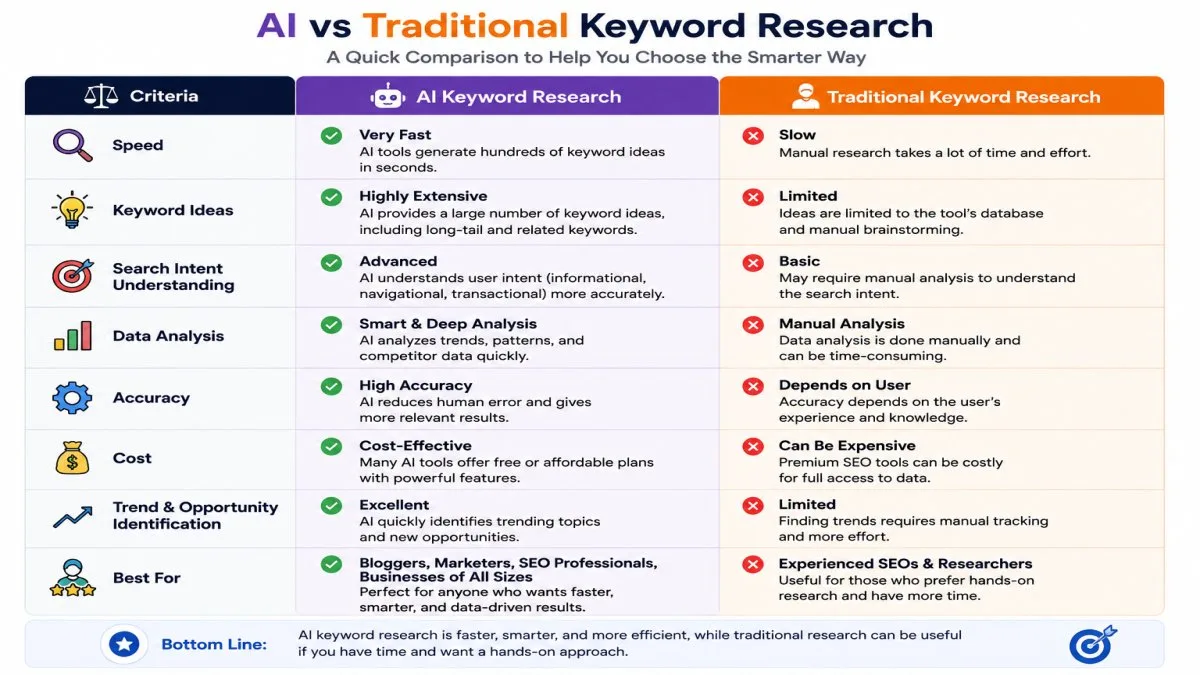
The short answer is No. AI is a powerful helper, but it cannot completely replace traditional keyword research.
AI tools like ChatGPT can quickly generate keyword ideas, suggest blog topics, explain search intent, and create content outlines. This makes keyword research much faster and easier, especially for beginners.
However, AI does not always provide real-time SEO data. It cannot reliably tell you the latest search volume, keyword difficulty, or how competitive a keyword is. For this information, you should use trusted SEO tools such as Google Keyword Planner, Ahrefs, or Semrush.
What AI Does Well
AI is very good at helping you:
- Generate keyword ideas
- Find long-tail keywords
- Understand search intent
- Create blog outlines
- Suggest content ideas
- Save time during research
Example:
If you ask ChatGPT:
Suggest keyword ideas for “AI image generators.”
It can quickly give you keywords like:
- best AI image generators
- free AI image generator
- AI image tools for beginners
- AI art generator
This gives you a great starting point for your research.
Where Traditional SEO Tools Are Better
Traditional SEO tools provide real data that AI cannot always provide accurately.
These tools can show:
- Monthly search volume
- Keyword difficulty
- Competition level
- Ranking keywords
- Competitor analysis
- Search trends
Example:
You find a keyword using ChatGPT.
Then you check it in Google Keyword Planner or Ahrefs to see whether enough people search for it and whether it is easy or difficult to rank.
This helps you make better SEO decisions.
The Best Strategy: Use AI and SEO Tools Together
Instead of choosing between AI and traditional keyword research, use both together.
A simple workflow is:
- Use ChatGPT to generate keyword ideas.
- Choose the most relevant keywords.
- Check search volume and keyword difficulty with an SEO tool.
- Create a helpful article based on user search intent.
- Review your content before publishing.
This combination saves time and improves the quality of your keyword research.
Example
Imagine you want to write an article about AI tools for bloggers.
Step 1: ChatGPT suggests:
- AI tools for bloggers
- best AI blogging tools
- free AI writing tools
Step 2: You check these keywords in an SEO tool.
You discover that best AI blogging tools has good search volume and lower competition.
Step 3: You choose it as your primary keyword and start writing your article.
This process is much smarter than using only AI or only an SEO tool.
Final Thoughts
AI is an excellent assistant, but it should not make every decision for you. Always combine AI suggestions with real SEO data and your own judgment.
When you use AI and trusted SEO tools together, you can find better keywords, understand your audience, and create helpful content that has a better chance of ranking on Google.
Quick Summary
Let’s quickly review what you have learned about how to do keyword research using AI tools.
- Keyword research helps you find what people are searching for on Google.
- AI tools make keyword research faster and easier.
- Start with a clear topic and choose a seed keyword.
- Use AI tools like ChatGPT to generate keyword ideas.
- Find long-tail keywords that match your topic.
- Understand the user’s search intent before choosing a keyword.
- Check search volume and keyword difficulty using trusted SEO tools.
- Choose one primary keyword and a few related secondary keywords.
- Create helpful content that answers the reader’s questions.
- Avoid keyword stuffing and other common SEO mistakes.
- Review your article before publishing.
Simple Example
Imagine you want to write a blog about AI tools for students.
You can follow these simple steps:
- Choose the topic.
- Use ChatGPT to find keyword ideas.
- Check the keywords with an SEO tool.
- Select the best primary and secondary keywords.
- Write a helpful article that answers the reader’s questions.
By following this process, you can create content that is useful for readers and has a better chance of ranking on Google.
Key Takeaways
- AI saves time, but it does not replace SEO tools.
- Always verify keyword data before using it.
- Focus on helping readers, not just adding keywords.
- Use keywords naturally throughout your article.
- Keep learning and improving your keyword research skills.
If you follow these best practices, you can build a strong SEO strategy and create high-quality content that brings more organic traffic to your website.
Frequently Asked Questions
1. What is AI keyword research?
AI keyword research is the process of using AI tools to find keyword ideas for your website or blog. These tools help you discover what people are searching for and suggest topics that match user search intent.
Example: You ask ChatGPT for keywords about AI blogging, and it suggests several related keyword ideas.
2. Can ChatGPT do keyword research?
Yes, ChatGPT can help with keyword research. It can generate keyword ideas, suggest long-tail keywords, explain search intent, and create article outlines.
However, ChatGPT does not always provide real-time SEO data. You should check search volume and keyword difficulty using trusted SEO tools.
3. Which AI tool is best for keyword research?
There is no single best tool for everyone.
- ChatGPT is great for keyword ideas and content planning.
- Google Keyword Planner helps you check search volume.
- Ahrefs and Semrush are better for detailed SEO analysis.
- Ubersuggest is a good choice for beginners.
Choose the tool that matches your needs and budget.
4. Are free AI keyword research tools good enough?
Yes, free AI tools are a good place to start.
For example, you can use ChatGPT for keyword ideas and Google Keyword Planner for basic keyword data.
As your website grows, you may want to use paid SEO tools for more detailed information.
5. How do beginners start keyword research?
Beginners can follow these simple steps:
- Choose a topic.
- Find a seed keyword.
- Use ChatGPT to generate keyword ideas.
- Check search volume and keyword difficulty.
- Write helpful content for your readers.
This simple process is easy to follow and works for most blog topics.
6. What is a long-tail keyword?
A long-tail keyword is a longer and more specific search phrase.
Example:
Short keyword:
- AI tools
Long-tail keyword:
- best AI tools for students
Long-tail keywords often have lower competition and attract more targeted visitors.
7. What is keyword difficulty?
Keyword difficulty shows how hard it is to rank for a keyword on Google.
A keyword with high difficulty usually has strong competition, while a keyword with lower difficulty may be easier to rank for.
If your website is new, it is often better to choose keywords with lower competition.
8. Can AI improve SEO rankings?
AI can help improve your SEO by making keyword research faster and giving you useful content ideas.
However, AI alone cannot improve rankings.
To rank well on Google, you also need:
- Helpful and original content
- Good user experience
- Proper on-page SEO
- High-quality backlinks
- Regular content updates
When you combine AI with good SEO practices, you have a better chance of getting higher rankings.
Conclusion
Learning how to do keyword research using AI tools is a valuable skill for every blogger and website owner. AI can help you find keyword ideas, understand search intent, and plan your content faster. However, the best results come when you combine AI with trusted SEO tools and your own research.
Don’t worry if you are a beginner. The more you practice with AI tools, the better your keyword research skills will become. Always focus on user intent and create content that truly answers your readers’ questions. Instead of chasing keywords, aim to write helpful, original, and easy-to-understand content. This approach will help you build trust with your audience and improve your chances of ranking higher on Google.
At UseAiLearn, our goal is to help you learn AI in a simple and practical way. Keep learning, keep practicing, and use AI wisely to create better content and grow your website.