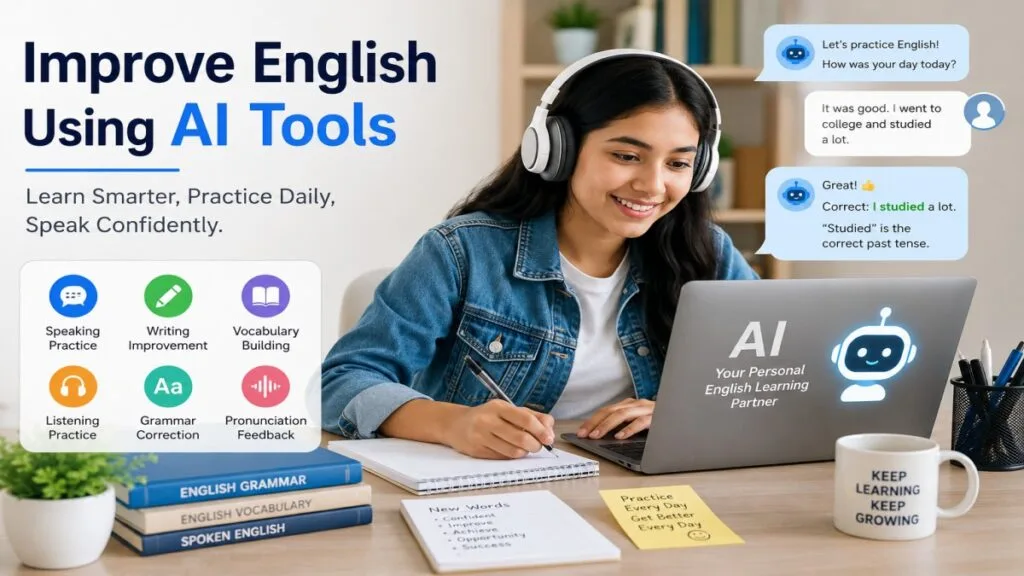
English is one of the most useful skills in today’s world. It helps you study, get a better job, travel, and talk to people from different countries. However, many learners find it hard to improve their English because they do not know where to practice or how to stay consistent.
The good news is that you can now improve English using AI tools in a simple and fun way. Modern AI tools for learning English can help you practice speaking, writing, grammar, vocabulary, pronunciation, and listening anytime. They also give instant feedback, so you can learn from your mistakes and improve faster.
In this beginner-friendly guide from UseAiLearn, you will learn how to improve English using AI tools step by step. We will also explore some of the best AI tools for English practice, practical learning tips, and daily practice methods that can help you become more confident in English. Whether you are a student, job seeker, blogger, freelancer, or professional, this guide will help you start learning English with AI in an easy and effective way.
Quick Answer: You can improve English using AI tools by practicing speaking, writing, grammar, vocabulary, pronunciation, and listening every day. AI gives instant feedback, personalized lessons, and 24/7 practice, making English learning easier and faster for beginners.
What Does It Mean to Improve English Using AI Tools?
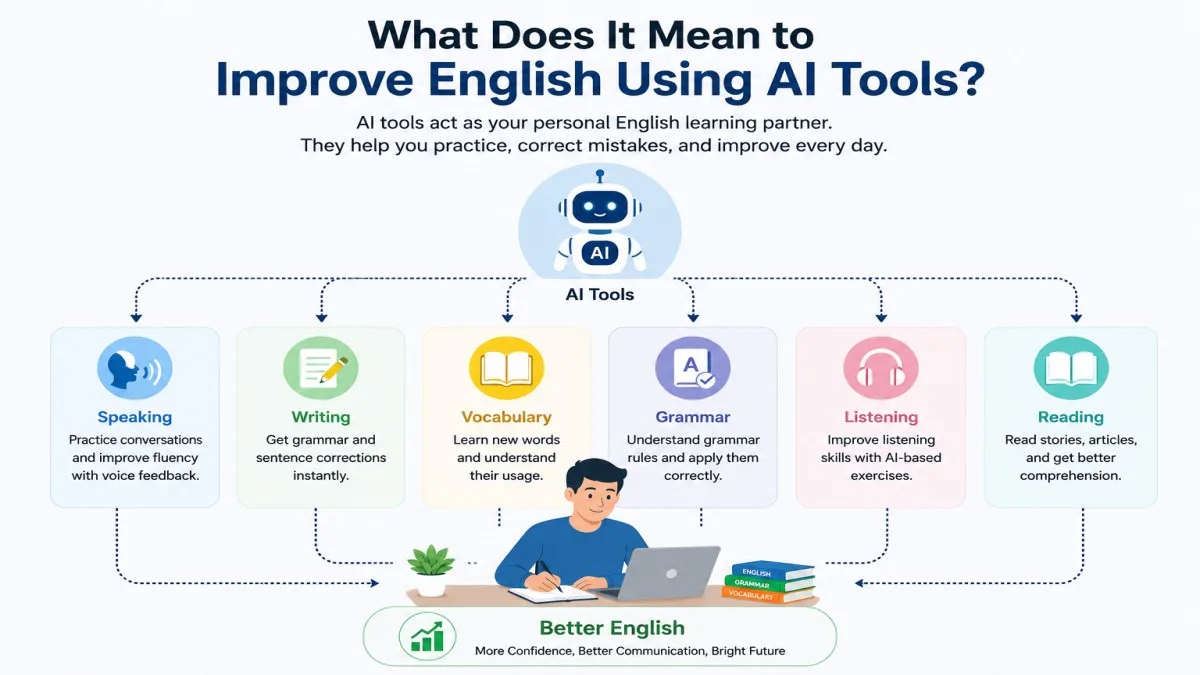
Improving English using AI tools means learning and practicing English with the help of artificial intelligence. Instead of learning alone, you can use AI as your personal learning partner. AI helps you practice speaking, writing, grammar, vocabulary, pronunciation, listening, and reading whenever you want. Do you want to know What is AI/Artificial Intelligence?
Unlike traditional learning, AI gives you instant feedback. It can find your mistakes, explain them in simple words, and suggest better sentences. This helps you learn faster and build confidence step by step.
For example, if you write, “She go to school every day,” an AI tool can correct it to “She goes to school every day” and explain why “goes” is the correct word. If you are practicing speaking, some AI tools can also tell you how to pronounce words more clearly.
How AI Helps You Learn Faster
AI helps you learn English in a smarter and more personal way. It understands your learning level and gives lessons based on your progress. If you are a beginner, it starts with simple words and easy conversations. As you improve, it gives you more challenging exercises.
Here are some ways AI helps you learn faster:
- Gives instant grammar corrections.
- Suggests better vocabulary and sentence ideas.
- Lets you practice English conversations anytime.
- Helps improve pronunciation with voice feedback.
- Creates personalized learning exercises.
- Tracks your progress over time.
Example:
Suppose you want to improve your English speaking. You can ask an AI chatbot:
“Let’s have a 5-minute conversation in English.”
The AI will reply like a real conversation partner. If you make a mistake, it will correct you and explain how to say it better. This helps you learn naturally through daily practice.
Why AI Is Better Than Traditional Practice for Many Learners
Many people cannot attend English classes every day because of time, cost, or location. AI tools solve this problem by making learning more flexible and convenient.
Here are some reasons why many learners prefer AI:
- You can learn anytime, day or night.
- Most AI tools are free or have free plans.
- You can practice without feeling shy or embarrassed.
- You learn at your own speed.
- You receive instant feedback instead of waiting for a teacher.
- You can practice every day using your phone or computer.
Example:
Imagine you have only 20 minutes after work or college. Instead of waiting for your next English class, you can open an AI tool, practice speaking, check your grammar, learn five new words, and improve your writing—all in one short session.
This makes learning English easier, more flexible, and more enjoyable for busy learners.
Quick Tip: Start with one AI tool instead of using many. This helps you stay focused and build a daily learning habit.
Benefits of Using AI Tools for Learning English
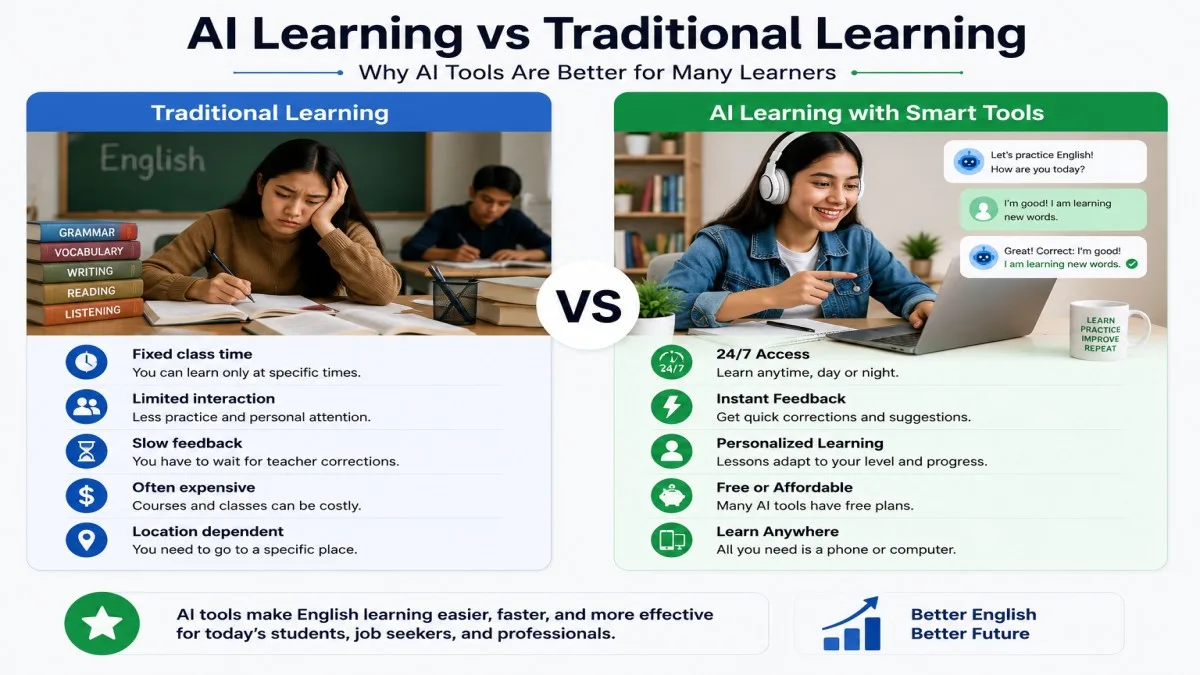
AI tools make learning English easier, faster, and more enjoyable. They help you practice every day and improve different English skills without needing a classroom. Whether you are a beginner or already know some English, AI tools can support your learning journey.
Learn Anytime and Anywhere
One of the biggest benefits of AI tools is that you can learn whenever you have free time. You only need a phone, tablet, or computer with an internet connection.
Example:
You can practice English for 15 minutes while traveling, during your lunch break, or before going to bed.
Get Instant Feedback
AI tools check your grammar, spelling, vocabulary, and sentence structure in just a few seconds. Instead of waiting for a teacher, you get corrections immediately.
Example:
If you write, “I am interesting in AI,” an AI tool will correct it to “I am interested in AI” and explain the difference.
Practice Speaking Without Fear
Many people feel shy when speaking English with others. AI tools let you practice in a private and comfortable way. You can make mistakes, learn from them, and try again without feeling embarrassed.
Example:
You can have a short English conversation with an AI chatbot every day to build confidence.
Improve All English Skills
AI tools do more than just fix grammar. They help you improve speaking, writing, reading, listening, vocabulary, and pronunciation in one place.
Example:
In one study session, you can read an English article, learn new words, practice speaking, and check your writing.
Personalized Learning
Everyone learns at a different speed. AI tools understand your progress and suggest lessons that match your current level. This makes learning easier and more effective.
Example:
If you are a beginner, AI will give you simple words and easy conversations. As your English improves, it will provide more advanced exercises.
Save Time and Money
Many AI tools offer free plans or affordable premium features. This means you can learn English without paying for expensive classes.
Example:
Instead of joining a daily coaching class, you can practice with free AI tools from your home.
Build Confidence Through Daily Practice
The more you practice, the more confident you become. AI encourages you to learn every day with small lessons, quizzes, and conversations.
Example:
If you practice for just 20 minutes every day, your vocabulary, grammar, and speaking skills can improve over time.
Quick Summary
Here are the main benefits of using AI tools for learning English:
- Learn anytime and anywhere.
- Get instant grammar and writing feedback.
- Practice speaking without fear.
- Improve speaking, writing, reading, listening, and vocabulary.
- Follow a learning plan based on your level.
- Save time and money.
- Build confidence with daily practice.
Best AI Tools to Improve English
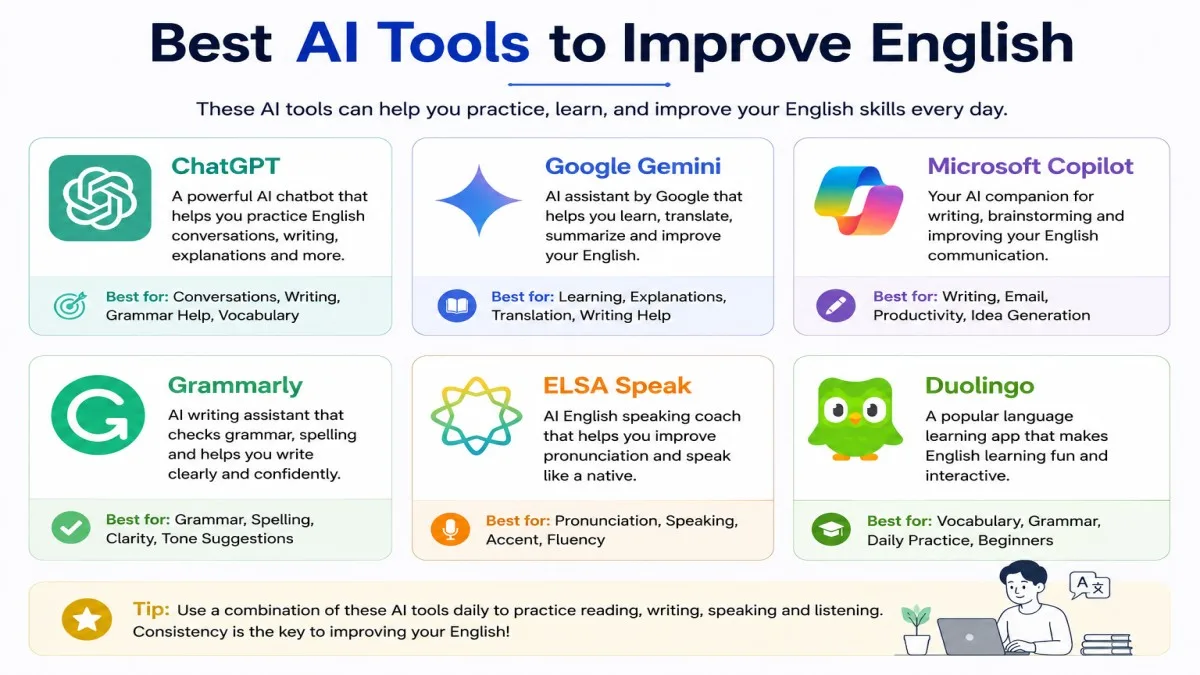
Today, many AI tools can help you learn English in a simple and smart way. Some tools are best for speaking, while others are great for grammar, writing, or pronunciation. The best choice depends on your learning goal.
Below are some of the best AI tools for learning English.
ChatGPT – Best for Daily English Practice
OpenAI ChatGPT is one of the most popular AI tools for learning English. You can ask questions, practice conversations, improve grammar, write emails, and learn new vocabulary.
Best for:
- Speaking practice
- Writing practice
- Grammar correction
- Vocabulary learning
- Daily conversations
Example:
Ask ChatGPT:
“Talk to me in simple English for 10 minutes.”
It will have a natural conversation with you and help correct your mistakes.
Do you want to know What Is ChatGPT and How Does It Work?
Google Gemini – Best for Learning and Research
Google Google Gemini helps you understand English, answer questions, summarize articles, and improve your writing. It is useful for students and professionals.
Best for:
- Reading practice
- Writing improvement
- Learning new topics
- Asking English questions
Example:
Paste a difficult English paragraph and ask Gemini to explain it in simple English.
Microsoft Copilot – Best for Writing and Productivity
Microsoft Microsoft Copilot helps you write emails, documents, and reports in better English. It can also improve grammar and sentence structure.
Best for:
- Email writing
- Professional writing
- Grammar correction
- Office work
Example:
Write a short email and ask Copilot to make it more professional and error-free.
Grammarly – Best for Grammar and Writing
Grammarly Grammarly checks grammar, spelling, punctuation, and sentence clarity. It also suggests better words and writing improvements.
Best for:
- Grammar checking
- Spelling correction
- Essay writing
- Email writing
Example:
Write an English paragraph and Grammarly will highlight mistakes and suggest better sentences.
ELSA Speak – Best for Pronunciation
ELSA ELSA Speak uses AI to improve your English pronunciation. It listens to your voice and tells you which words need better pronunciation.
Best for:
- Pronunciation practice
- Speaking confidence
- Accent improvement
Example:
Read an English sentence aloud, and ELSA Speak will score your pronunciation and show how to improve it.
Duolingo – Best for Beginners
Duolingo Duolingo makes English learning fun with short lessons, quizzes, and daily challenges. Its AI-powered features help you practice every day.
Best for:
- Beginners
- Vocabulary
- Grammar basics
- Daily learning habits
Example:
Complete one short lesson every day to build your vocabulary and improve basic English.
Comparison Table
| AI Tool | Best For | Free Version And Beginners Friendly |
|---|---|---|
| ChatGPT | Speaking, writing, grammar | Yes, ✅yes |
| Google Gemini | Reading, learning, writing | Yes, ✅yes |
| Microsoft Copilot | Emails and professional writing | Yes, ✅yes |
| Grammarly | Grammar and spelling | Yes, ✅yes |
| ELSA Speak | Pronunciation practice | Yes (limited), ✅yes |
| Duolingo | Daily English learning | Yes, ✅yes |
Which AI Tool Should You Choose?
Choose the tool based on your goal:
- Want to improve speaking? → ChatGPT or ELSA Speak.
- Want better grammar? → Grammarly.
- Want to improve writing? → ChatGPT, Google Gemini, or Microsoft Copilot.
- Want to build daily learning habits? → Duolingo.
- Want to understand difficult English? → Google Gemini.
You can also use two or three AI tools together. For example, practice speaking with ChatGPT, check your grammar with Grammarly, and improve pronunciation with ELSA Speak.
How to Improve English Using AI Tools (Step-by-Step)
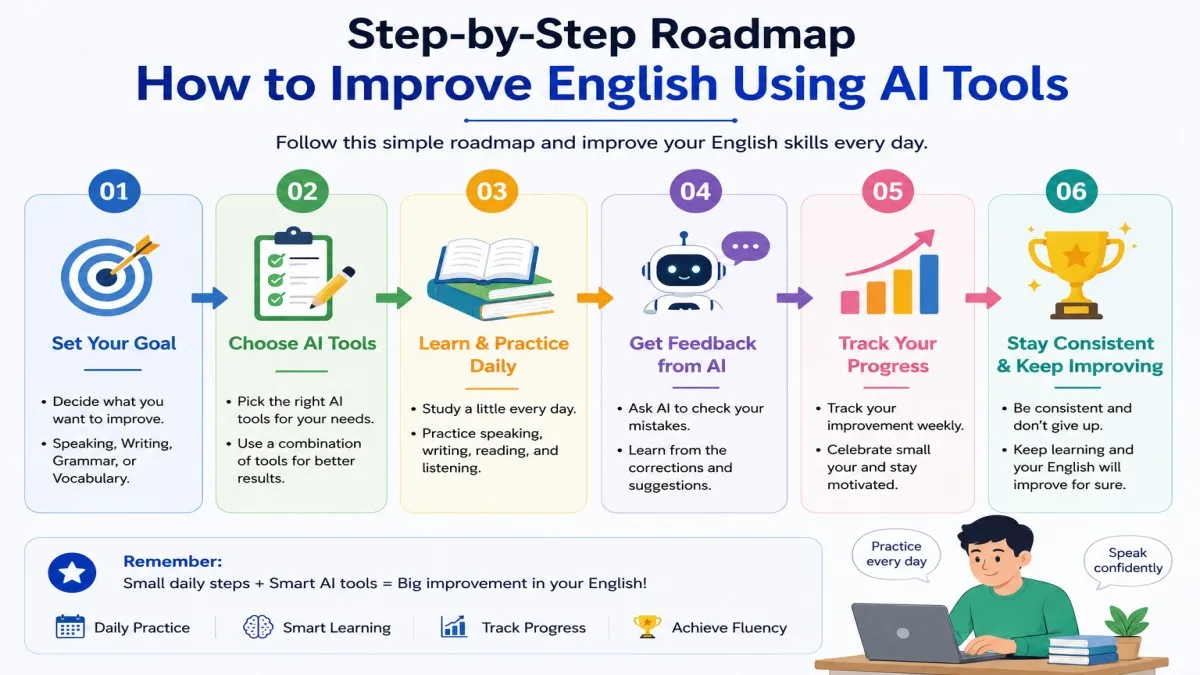
Learning English with AI is easy when you follow a simple daily plan. You do not need to study for many hours. Even 20 to 30 minutes of practice every day can help you improve. Follow these steps to build your English skills one step at a time.
Step 1: Set Your English Learning Goal
Before you start, decide why you want to learn English. A clear goal helps you stay focused and choose the right AI tools.
Your goal could be:
- Speak English confidently.
- Improve grammar.
- Learn more vocabulary.
- Write better emails.
- Prepare for job interviews.
- Improve English for school or college.
Example:
Instead of saying, “I want to learn English,” say, “I want to speak English confidently in three months.”
Step 2: Practice Speaking Every Day
Speaking is one of the fastest ways to improve your English. Use an AI chatbot to have short conversations every day.
You can ask questions, answer simple topics, or practice daily conversations.
Example Prompt:
“Talk to me in simple English for 10 minutes. Correct my grammar after every reply.”
Doing this every day will improve your confidence and speaking skills.
Step 3: Improve Your Grammar
Good grammar helps you speak and write correctly. AI tools can find your grammar mistakes and explain them in simple words.
Example:
You write:
“He don’t like coffee.”
AI corrects it to:
“He doesn’t like coffee.”
It also explains why “doesn’t” is the correct word.
Step 4: Learn New Vocabulary
Learning a few new words every day can make a big difference. Ask AI to teach you useful words with meanings and example sentences.
Example Prompt:
“Teach me 10 common English words with meanings and simple examples.”
Try to use those words in your own sentences.
Step 5: Practice Writing
Writing helps you organize your thoughts in English. Write short paragraphs, emails, or diary entries and ask AI to check them.
AI can improve:
- Grammar
- Vocabulary
- Sentence structure
- Clarity
Example:
Write about your day in 100 words and ask AI to improve it without changing the meaning.
Step 6: Improve Your Pronunciation
Correct pronunciation makes your English easier to understand. Some AI tools listen to your voice and tell you which words need improvement.
Example:
Read a short English paragraph aloud. The AI tool will highlight words that need better pronunciation and show you how to say them correctly.
Step 7: Practice Listening
Listening is just as important as speaking. Listen to short English conversations, stories, or podcasts, and ask AI to explain difficult words or sentences.
Example:
Watch a short English video and ask AI:
“Explain this video in simple English.”
This improves both your listening and understanding.
Step 8: Track Your Progress
Learning English takes time, so check your progress every week.
Ask yourself:
- Can I speak more confidently?
- Have I learned new words?
- Am I making fewer grammar mistakes?
- Can I understand more English than before?
Keep a notebook or digital journal to write your progress.
Example:
Every Sunday, write five sentences about what you learned during the week and ask AI to review them.
Daily Practice Tip
You do not need to study for many hours. A simple daily routine works well.
- 10 minutes: Speaking practice
- 5 minutes: Grammar correction
- 5 minutes: Learn new vocabulary
- 10 minutes: Writing or listening practice
Just 30 minutes every day can help you improve your English over time.
Note: Language learning experts generally agree that consistent daily practice is more effective than occasional long study sessions.
Daily AI English Learning Routine
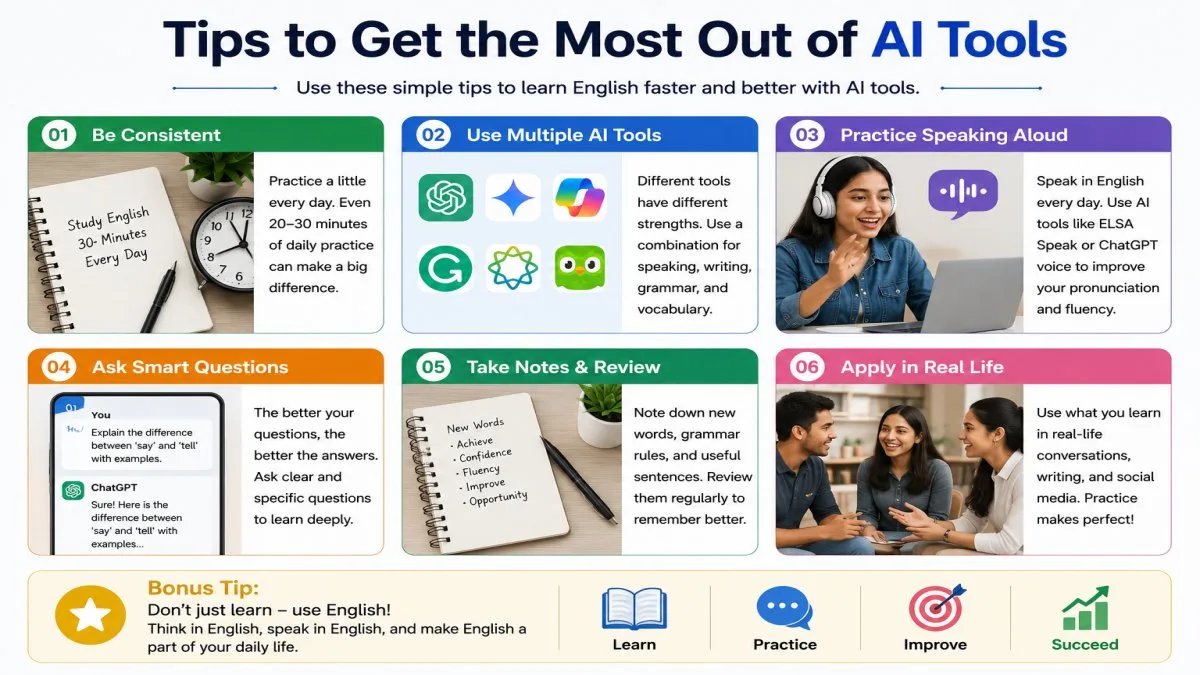
A daily routine is one of the best ways to improve your English. You do not need to study for many hours. If you practice for 20 to 30 minutes every day, you can improve your speaking, writing, grammar, vocabulary, and pronunciation over time.
The routine below is simple and suitable for beginners.
Morning: Learn New Words (5–10 Minutes)
Start your day by learning a few new English words. Ask an AI tool to teach you useful words with meanings and simple example sentences.
Example Prompt:
“Teach me 5 useful English words with meanings and simple examples.”
After learning the words, try to make your own sentences.
Example:
New Word: Confident
Sentence: I feel confident before my English test.
Afternoon: Practice Speaking (10 Minutes)
Talk to an AI chatbot in English. Choose a simple topic like your hobbies, daily routine, family, or favorite food.
Do not worry about making mistakes. AI will correct you and help you improve.
Example Prompt:
“Let’s have a 10-minute English conversation about my daily routine.”
This daily speaking practice will help you become more confident.
Evening: Improve Writing and Grammar (10 Minutes)
Write a short paragraph about your day. Then ask AI to check your grammar, spelling, and sentence structure.
Read the corrected version carefully and learn from your mistakes.
Example:
Write:
“Today I studied English and watched an English video.”
Then ask:
“Please correct my grammar and make my writing more natural.”
Before Bed: Practice Listening (5 Minutes)
Listen to a short English story, podcast, or video. If you do not understand something, ask AI to explain difficult words or sentences in simple English.
Example Prompt:
“Explain this English paragraph in simple words.”
This habit will improve your listening skills and help you understand English more easily.
Weekly Review
At the end of every week, spend a few minutes checking your progress.
Ask yourself:
- Did I practice every day?
- Did I learn new words?
- Is my grammar getting better?
- Am I speaking more confidently?
- What should I improve next week?
You can also ask AI to test your English with a small quiz or conversation.
Example Prompt:
“Give me a beginner English quiz based on what I learned this week.”
Sample Daily Routine Table
| Time | Activity | Time Needed |
|---|---|---|
| Morning | Learn 5 new English words | 5–10 minutes |
| Afternoon | Speaking practice with AI | 10 minutes |
| Evening | Writing and grammar practice | 10 minutes |
| Before Bed | Listening practice | 5 minutes |
| Every Sunday | Review your weekly progress | 15–20 minutes |
Tips to Follow This Routine
- Practice at the same time every day.
- Focus on one skill at a time.
- Do not worry about making mistakes.
- Review old vocabulary every week.
- Stay consistent, even if you have only 15–20 minutes.
Small daily practice is better than studying for many hours only once a week.
My Practical Advice: While creating this guide for UseAiLearn, I found that beginners improved faster when they practiced speaking for just 10–15 minutes daily instead of studying for long hours only once a week. Small daily practice was easier to maintain.
Real-Life Examples of Learning English with AI
Many people use AI tools every day to improve their English. Students, job seekers, bloggers, and professionals all have different learning goals. The good thing is that AI can help each person in a simple and practical way.
Here are some real-life examples to show how AI tools can make English learning easier.
Example 1: A Student Improves English for School
Rahul is a college student. He understands basic English but finds it difficult to write assignments and answer questions in English.
He starts using AI every day for 20 minutes.
His daily routine is:
- Learn 5 new English words.
- Practice grammar with AI.
- Write a short paragraph.
- Ask AI to correct mistakes.
After two months, Rahul writes better assignments, learns more vocabulary, and feels more confident during class.
What Rahul learned:
- Better grammar
- More vocabulary
- Better writing skills
- More confidence
Example 2: A Job Seeker Prepares for Interviews
Priya wants to get a new job. She knows that many interviews are conducted in English, but she feels nervous while speaking.
She uses an AI chatbot to practice interview questions every evening.
She asks AI:
“Act like an interviewer and ask me common interview questions.”
The AI asks questions, checks her answers, and suggests better sentences.
After a few weeks, Priya becomes more confident and answers interview questions more clearly.
What Priya improved:
- English speaking
- Interview communication
- Grammar
- Confidence
Example 3: A Blogger Writes Better Articles
Amit writes blog posts, but he often makes grammar mistakes and uses simple vocabulary.
He starts using AI to improve his articles.
His workflow is:
- Write the first draft.
- Ask AI to improve grammar.
- Replace difficult sentences with simple English.
- Check spelling and readability.
As a result, his articles become easier to read and look more professional.
What Amit improved:
- Writing quality
- Grammar
- Vocabulary
- Readability
What We Can Learn from These Examples
These examples show that AI is not only for students. Anyone can use AI to improve English.
Whether you want to:
- Speak English with confidence
- Write better emails
- Prepare for interviews
- Improve grammar
- Learn new vocabulary
- Create better blog posts
AI tools can help you reach your goal faster when you practice regularly.
The most important thing is to stay consistent. Even 20–30 minutes of daily practice can make a big difference over time.
Common Mistakes to Avoid
AI tools can help you improve your English, but they are not magic. Many learners make small mistakes that slow down their progress. If you avoid these mistakes, you can learn English faster and more effectively.
1. Depending Only on AI
AI is a great learning partner, but it should not be your only teacher. You should also read English books, watch videos, listen to podcasts, and talk to real people whenever possible.
Example:
If you only ask AI grammar questions but never speak English, your speaking skills will improve very slowly.
2. Not Practicing Every Day
Many people study for one day and then stop for a week. This makes learning difficult because they forget what they learned.
Example:
Practicing for 20 minutes every day is much better than studying for 3 hours only on Sunday.
3. Being Afraid of Making Mistakes
Some learners do not speak English because they are afraid of making mistakes. This is one of the biggest reasons why progress becomes slow.
Remember, every mistake is a chance to learn.
Example:
If AI corrects your sentence, do not feel bad. Read the correction, understand it, and try again.
4. Learning Too Many New Words at Once
Trying to learn 50 or 100 new words in one day can be confusing. It is better to learn a few useful words and use them in real sentences.
Example:
Instead of learning 30 new words today, learn 5 words, make your own sentences, and review them tomorrow.
5. Ignoring AI Feedback
AI gives suggestions to help you improve. If you ignore those suggestions, you may keep making the same mistakes again and again.
Example:
If AI corrects your grammar, read the explanation carefully before moving to the next lesson.
6. Copying AI Answers Without Understanding
Some learners copy AI-generated sentences without understanding their meaning. This does not improve real English skills.
Example:
If AI writes a paragraph for you, read it carefully, learn the new words, and try writing a similar paragraph in your own words.
7. Not Setting a Learning Goal
Without a clear goal, it is easy to lose motivation.
Set a simple goal like:
- Learn 5 new words every day.
- Practice speaking for 10 minutes.
- Write one short paragraph daily.
A clear goal helps you stay focused and measure your progress.
Quick Tips to Avoid These Mistakes
- Practice English every day.
- Use AI as a learning partner, not as a shortcut.
- Learn from your mistakes.
- Review AI feedback carefully.
- Focus on understanding instead of copying.
- Set small weekly goals.
- Stay patient and consistent.
Tips- “Many beginners make the mistake of only reading AI answers. In our testing, learners improved faster when they wrote their own sentences first and then asked AI for corrections.”
Tips to Learn English Faster with AI
Learning English with AI is easy, but using the right methods can help you improve much faster. You do not need to spend many hours every day. Small and consistent practice is the key to success.
Here are some simple tips to help you learn English faster with AI.
1. Practice Every Day
The best way to improve your English is to practice every day. Even 20–30 minutes of daily practice is better than studying for many hours only once a week.
Example:
Practice speaking for 10 minutes, learn 5 new words, and write one short paragraph every day.
2. Speak with AI Like a Real Friend
Do not use AI only for asking questions. Have real conversations with it. The more you speak, the more confident you will become.
Example Prompt:
“Let’s have a friendly conversation in simple English for 10 minutes.”
3. Learn New Words in Sentences
Do not memorize long vocabulary lists. Learn new words with example sentences so you know how to use them in real life.
Example:
New Word: Opportunity
Sentence: Learning English gives me more job opportunities.
4. Ask AI to Correct Your Mistakes
Whenever you write or speak in English, ask AI to correct your grammar and explain your mistakes.
Example Prompt:
“Correct my grammar and explain every mistake in simple English.”
This helps you avoid making the same mistakes again.
5. Read Something in English Every Day
Reading improves your vocabulary, grammar, and sentence structure.
You can read:
- Short articles
- News
- Blog posts
- Stories
- Emails
If you find difficult words, ask AI to explain them.
Example Prompt:
“Explain this paragraph in simple English.”
6. Write a Little Every Day
Writing helps you remember new words and grammar rules.
You can write:
- A daily diary
- A short email
- A social media post
- A paragraph about your day
Then ask AI to improve your writing.
7. Listen to English Every Day
Listening helps you understand how native speakers use English.
You can listen to:
- Podcasts
- Short videos
- Audiobooks
- English conversations
If something is difficult to understand, ask AI to explain it.
8. Review Your Progress Every Week
Do not only learn new things. Review what you learned during the week.
Ask yourself:
- What new words did I learn?
- What grammar mistakes did I fix?
- Can I speak more confidently now?
You can also ask AI to give you a short quiz.
9. Be Patient and Stay Consistent
Learning English takes time. Some days you will improve quickly, and some days you may feel slow. This is completely normal.
Do not give up. Keep practicing every day, and you will see progress over time.
Quick Recap
To learn English faster with AI:
- Practice every day.
- Talk to AI like a real person.
- Learn vocabulary with examples.
- Ask AI to correct your mistakes.
- Read English daily.
- Write a little every day.
- Listen to English regularly.
- Review your progress every week.
- Stay patient and consistent.
UseAiLearn Tip: If you are completely new to English, do not try five AI tools at once. Start with ChatGPT for conversations and Grammarly for writing. After two weeks, add another tool if needed.
Pros and Cons of AI Tools for English Learning
AI tools have changed the way people learn English. They make learning easier, faster, and more flexible. However, like any technology, AI tools have both advantages and disadvantages. Understanding both sides will help you use them more effectively.
Pros of AI Tools for English Learning
1. Learn Anytime and Anywhere
You can practice English whenever you have free time. You only need a phone, tablet, or computer with an internet connection.
Example:
You can practice English while traveling, during a lunch break, or before going to bed.
2. Get Instant Feedback
AI tools quickly check your grammar, spelling, vocabulary, and sentence structure. You do not have to wait for a teacher to review your work.
Example:
If you write, “He go to work every day,” AI will correct it to “He goes to work every day” and explain the mistake.
3. Practice Without Feeling Shy
Many learners are afraid of speaking English in front of others. AI lets you practice privately without worrying about making mistakes.
Example:
You can have daily conversations with an AI chatbot until you feel more confident.
4. Personalized Learning
AI tools adjust lessons based on your learning level and progress. Beginners get simple exercises, while advanced learners receive more challenging tasks.
Example:
If you improve your vocabulary, AI may suggest more advanced reading and writing exercises.
5. Save Time and Money
Many AI tools have free versions, so you can learn English without paying for expensive coaching classes.
Example:
Instead of attending daily tuition, you can use free AI tools to practice from home.
Cons of AI Tools for English Learning
1. AI Can Make Mistakes
AI is helpful, but it is not perfect. Sometimes it may give incorrect information or unnatural sentences.
Example:
If an AI answer sounds confusing, check it with another trusted source like a dictionary or English grammar book.
2. Less Human Interaction
Talking only with AI cannot fully replace conversations with real people. Real conversations help you understand emotions, body language, and natural speaking styles.
Example:
Practice with AI every day, but also try speaking with your teacher, friends, or language partners.
3. Too Much Dependence on AI
If you always ask AI for answers, you may stop thinking and writing on your own.
Example:
Instead of copying AI’s paragraph, first write your own version and then ask AI to improve it.
4. Some Features Require Payment
Many AI tools are free, but advanced features often require a paid subscription.
Example:
Free plans may have daily limits or fewer learning features compared to premium plans.
Pros and Cons Comparison Table
| Pros | Cons |
|---|---|
| Learn anytime and anywhere | AI can sometimes make mistakes |
| Instant grammar and writing feedback | Less real human interaction |
| Practice without feeling shy | Too much dependence can reduce learning |
| Personalized lessons | Some advanced features are paid |
| Saves time and money | Internet connection is usually needed |
In My Thoughts
AI tools are excellent learning partners, but they work best when you use them wisely. Combine AI with reading books, listening to English, and talking to real people. This balanced approach will help you improve your English faster and build long-term confidence.
Can AI Replace an English Teacher?
The short answer is No. AI is a powerful learning tool, but it cannot completely replace a good English teacher. AI can help you practice every day, correct your grammar, improve your vocabulary, and build your confidence. However, a teacher can provide personal guidance, understand your learning challenges, and motivate you in ways that AI cannot.
The best way to learn English is to use both AI tools and a teacher whenever possible. AI helps you practice daily, while a teacher helps you understand difficult topics and improve your communication skills.
What AI Can Do
AI tools can help you with many English learning tasks, such as:
- Practice English conversations anytime.
- Correct grammar and spelling mistakes.
- Suggest better words and sentences.
- Help improve pronunciation.
- Explain difficult grammar rules.
- Create quizzes and practice exercises.
- Give instant feedback.
Example:
You can ask an AI chatbot:
“Please have a 10-minute English conversation with me and correct my mistakes.”
The AI will reply, correct your grammar, and explain your errors immediately.
What an English Teacher Can Do
A good English teacher offers support that AI cannot fully provide.
A teacher can:
- Understand your learning style.
- Answer difficult questions in different ways.
- Give personal advice and motivation.
- Help you improve your confidence in real conversations.
- Teach communication skills, body language, and pronunciation during live interaction.
- Prepare you for exams, interviews, and presentations with personal feedback.
Example:
If you are preparing for an English interview, a teacher can observe your confidence, speaking style, eye contact, and communication skills. These are areas where AI has limitations.
AI vs English Teacher
| Feature | AI Tools | English Teacher |
|---|---|---|
| Available anytime | ✅ Yes | ❌ No |
| Instant grammar correction | ✅ Yes | ✅ Yes |
| Daily speaking practice | ✅ Yes | Limited |
| Personalized motivation | Limited | ✅ Yes |
| Real human conversation | ❌ No | ✅ Yes |
| Emotional support | ❌ No | ✅ Yes |
| Learning cost | Often free or low cost | Usually paid |
Which One Should You Choose?
The answer depends on your needs.
- If you want daily practice, AI tools are an excellent choice.
- If you need personal guidance or are preparing for an important exam or interview, an English teacher can provide valuable support.
- If possible, use both AI and a teacher. This combination gives you the best learning experience.
In My Opinion
AI is changing the way people learn English. It makes learning easier, faster, and more flexible. However, it is still a tool—not a complete replacement for a skilled teacher.
Think of AI as your 24/7 English practice partner and your teacher as your personal guide and mentor. Together, they can help you improve your English more effectively.
Frequently Asked Questions (FAQs)
1. Can AI really help me improve my English?
Yes. AI can help you improve your speaking, writing, grammar, vocabulary, pronunciation, and listening skills. It gives instant feedback and lets you practice every day.
Example:
You can ask an AI chatbot to correct your grammar or have a short conversation in English.
2. Which AI tool is best for beginners?
There is no single best tool for everyone. It depends on your learning goal. However, ChatGPT, Google Gemini, Grammarly, and Duolingo are great choices for beginners because they are easy to use.
Example:
If you want to practice speaking, ChatGPT is a good option. If you want to improve grammar, Grammarly is very helpful.
3. Is ChatGPT good for learning English?
Yes. ChatGPT is one of the best AI tools for English practice. You can ask questions, practice conversations, improve grammar, learn vocabulary, and even write emails or essays.
Example Prompt:
“Talk to me in simple English and correct my mistakes.”
4. Are free AI tools enough to learn English?
Yes, for most beginners. Many free AI tools provide enough features to improve your English. As your level grows, you can decide if you need a paid plan.
Example:
You can start with the free versions of ChatGPT, Google Gemini, Grammarly, and Duolingo.
5. How long does it take to improve English with AI?
It depends on how often you practice. If you practice for 20–30 minutes every day, you may notice improvement within a few weeks. Becoming fluent usually takes several months or longer, depending on your starting level and consistency.
Example:
A learner who practices daily will usually improve faster than someone who practices only once a week.
6. Can AI improve my English pronunciation?
Yes. Some AI tools can listen to your voice, find pronunciation mistakes, and suggest better ways to pronounce words.
Example:
You speak a sentence, and the AI tells you which words need better pronunciation.
7. Do I need to know English before using AI tools?
No. Most AI tools are beginner-friendly. You can start learning even if you know only a few English words.
Example:
You can ask AI to explain grammar or vocabulary in simple English or even in your native language.
8. What is the best way to learn English with AI?
The best way is to practice every day. Use AI for speaking, writing, grammar, vocabulary, pronunciation, and listening. Stay consistent and learn from your mistakes.
Example Daily Plan:
- 10 minutes speaking
- 5 minutes grammar
- 5 new words
- 10 minutes writing or listening
Final Tip
AI is a powerful learning partner, but your progress depends on your daily practice. Stay consistent, keep learning from your mistakes, and use AI as a tool to build your confidence. With regular practice, you can improve your English step by step.
Conclusion
Learning English does not have to be difficult. With the right AI tools and a simple daily routine, you can improve your speaking, writing, grammar, vocabulary, pronunciation, and listening skills step by step. The most important thing is to practice every day and learn from your mistakes.
Start with one or two AI tools instead of using too many at the same time. Set a small daily goal, such as learning five new words, practicing speaking for 10 minutes, or writing one short paragraph. These small habits can lead to big improvements over time.
If you want more beginner-friendly AI guides, practical tutorials, and the latest AI learning tips, explore more articles on UseAiLearn. Keep learning, stay consistent, and enjoy your English learning journey with AI.